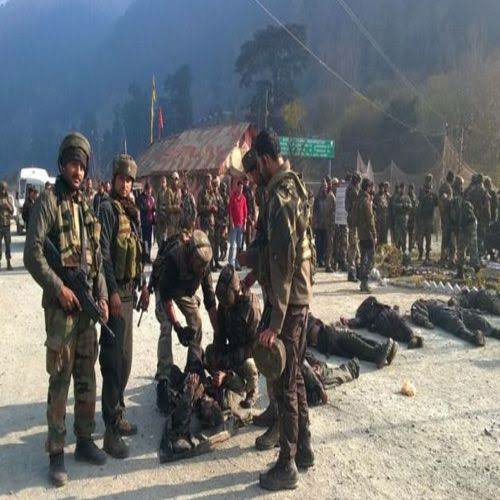
URI ATTACK

At around 5:30 a.m. on 18 September, four militants attacked an Indian Army brigade headquarters in Uri, near the Line of Control in a pre-dawn ambush. They were said to have lobbed 17 grenades in three minutes. As a rear administrative base camp with tents caught fire, 17 army personnel were killed during the attack.

An additional 19-30 soldiers were reported to have been injured. A gun battle ensued lasting six hours, during which all the four militants were killed. Combing operations continued to flush out additional terrorists thought to be alive.
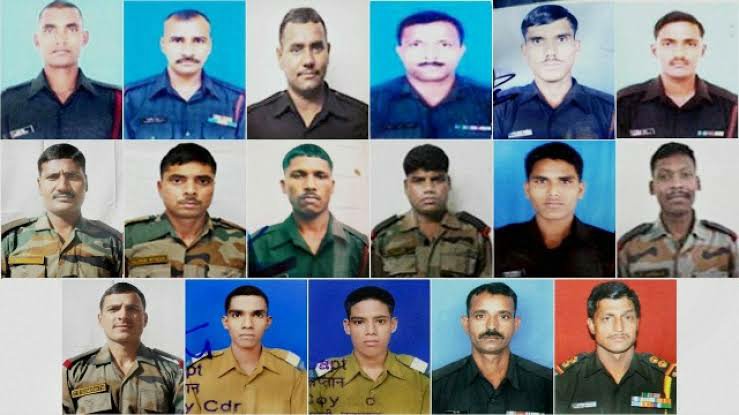
years of Uri terror attack: The day when Indian Army suffered its worst loss in 20 years
hree years ago on this day, the Indian Army suffered its biggest loss in the past two decades in Jammu and Kashmir. In the early hours of September 18, 2016, four heavily armed terrorists crossed the Line of Control (LoC), trekked for about six kilometres, breached a heavily guarded military camp in the Uri town of Jammu and Kashmir and launched a massive grenade attack.


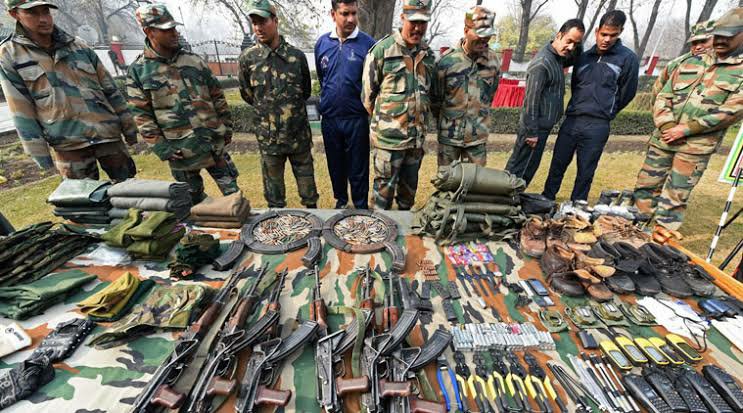
India gives Pakistan evidence of involvement of Pak-based terrorists
India on Wednesday summoned Pakistani high commissioner to India Abdul Basit and handed over to him evidence of Pak involvement in the Uri terror strike.

“Foreign secretary Jaishankar called in the high commissioner of Pakistan Abdul Basit today (Wednesday) and reminded him that the Government of Pakistan had made a solemn commitment in January 2004 to not allow its soil or territory under its control to be used for terrorism against India. The persistent and growing violation of this undertaking is a matter of very serious concern,” MEA said in a statement after the meeting.
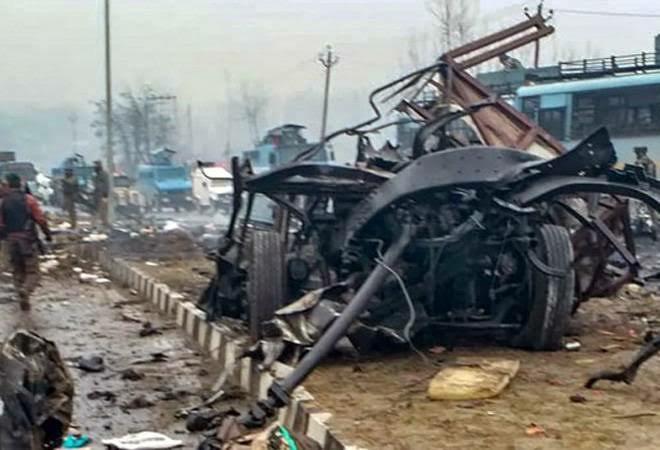
2019 Pulwama Attack

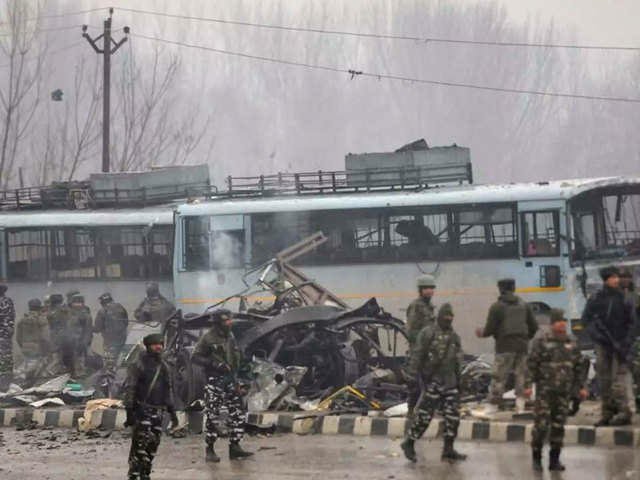
On 14 February 2019, a convoy of vehicles carrying security personnel on the Jammu Srinagar National Highway was attacked by a vehicle-borne suicide bomber at Lethpora (near higway) in the Pulwama district, Jammu and Kashmir, India. The attack resulted in the deaths of 40 Central Reserve Police Force (CRPF) personnel and the attacker. 

National Investigation Agency was able to establish and confirm the identity of suicide bomber as DNA samples from “meagre fragments of the car” used in suicide attack matched with Adil Ahmad Dar’s father. However, even after a year of investigation, NIA was unable to trace the source of explosives.

The outfit’s move to gather muscle to carry out more attacks were blunted with the killing of commander Qari Yasir and Moosa alias Abu Usmaan from Pakistan in an encounter in Hasipora Tral in Pulwama on January 25 this year.
“Yasir did pose a potential threat. His killing has brought down the recruitment of locals and the outfit’s striking capability”, said a top counter-insurgency police officer.
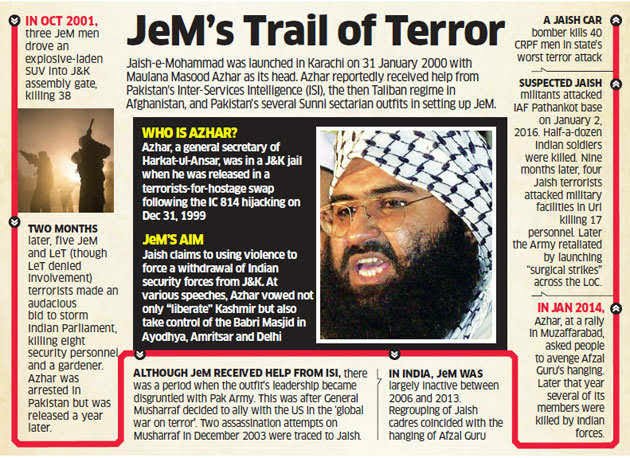
Mr Azhar reportedly met with the former Taliban leader Mullah Omar and with al-Qaeda head Osama Bin Laden when he was in the country.
India blame JeM for an attack on their parliament in New Delhi in December 2001 – a claim JeM denies.
JeM was officially banned in Pakistan soon after that attack but the group still operates, sometimes using the names Afzal Guru Squad, Al-Murabitoon and Tehreek-al-Furqan.
More recently, India has blamed JeM for an attack on its Pathankot airbase near the Pakistani border in January 2016, which left three security forces dead.

Revisiting the night of Mumbai terror attack: When 10 Pak terrorists attacked India’s financial capital

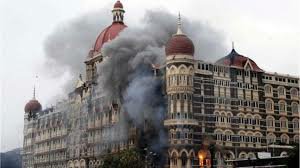
Lashkar-e-Taiba terrorists reached Mumbai on a hijacked fishing trawler from a Pakistani port in Karachi. While nine terrorists were killed in the four-day operation by the armed forces, the lone terrorist Ajmal Kasab was captured alive and sentenced to death at Yerwada Central Jail in Pune in 2012.The terrorists hijacked cars, including a police van, and split into different groups to carry out the attacks.

HOW INDIAN REACTED TO MUMBAI ATTACK 2008 Mumbai attacks shocked Indians like no other terror attack before. Dramatic pictures of the city’s iconic Taj Hotel in flames, explosions, fire-fights, a prolonged hostage crisis and the rescue were telecast live and non-stop for three days. Many called it “India’s 9/11.”In fact, many questioned why Kasab was kept alive in jail for so long with taxpayers’ money.

Every year on the anniversary of the attacks, survivors and members of victims’ families would ask when justice would be delivered.Surveillance cameras caught Kasab prowling with a gun in the train station that night, where 55 people were killed.

Terrorism

Terrorism is, in the broadest sense, the use of intentional violence, generally against civilians, for political purposes.It is used in this regard primarily to refer to violence during peacetime or in context of war against non-combatants (mostly civilians and neutral military personnel).The terms “terrorist” and “terrorism” originated during the French Revolution of the late 18th centurybut gained mainstream popularity in the 1970s in news reports and books covering the conflicts in Northern Ireland, the Basque Country and Palestine. The increased use of suicide attacks from the 1980s onwards was typified by the September 11 attacks in New York City and Washington, D.C. in 2001.

History

There are different definitions of terrorism.Terrorism is a charged term. It is often used with the connotation of something that is “morally wrong”. Governments and non-state groups use the term to abuse or denounce opposing groups.Varied political organizations have been accused of using terrorism to achieve their objectives. These organizations include right-wing and left-wing political organizations, nationalist groups, religious groups, revolutionaries and ruling governments.Legislation declaring terrorism a crime has been adopted in many states.When terrorism is perpetrated by nation-states it is not considered terrorism by the state conducting it, making legality a largely grey-area issue.There is no consensus as to whether or not terrorism should be regarded as a war crime.

Depending on how broadly the term is defined, the roots and practice of terrorism can be traced at least to the 1st-century AD.Sicarii Zealots, though some dispute whether the group, a radical offshoot of the Zealots which was active in Judaea Province at the beginning of the 1st century AD, was in fact terrorist. According to the contemporary Jewish-Roman historian Josephus, after the Zealotry rebellion against Roman rule in Judea, when some prominent Jewish collaborators with Roman rule were killed,Judas of Galilee formed a small and more extreme offshoot of the Zealots, the Sicarii, in 6 AD. Their terror was directed against Jewish “collaborators”, including temple priests, Sadducees, Herodians, and other wealthy elites.